Posts Tagged ‘learning problems’
 “Tyranny of Words” – Stuart Chase
 June 2nd, 2021 |
  Author:
 https://www.goodreads.com/book/show/2343374.The_Tyranny_of_Words
Dear Reader,
I have been very interested in words since I was a very young child. One of my all-time favorite books on word usage is Korzybski’s “Science and Sanity.”
I was asked to comment on another book:
Stuart Chase’s “The Tyranny of Words.” Maybe this is because I have tended to write and speak of the positive power of words, not the negative power of words.
I remember reading in the Bible:
“Out of the same mouth come blessing and cursing…. these things ought not to be so” (James 3:10).
Assuredly.
Sincerely,
Doc Meek, Sherwood Park, Alberta, Canada, June 2, 2021
“Super Sensitive Smell.” – Doc Meek
Today I am grateful for people who are very sensitive and for those who help them, like Sharon Heller, expert and author. – Doc Meek  Image from: 123rf.com
Super Sensitive Smell
My first experience with super senses came when I first started my private practice at THE LEARNING CLINIC, several decades ago now.
A young boy was brought in by his mother, who was worried about his problems at school and at home. She introduced me to Jackson (not his real name) and asked me to speak with him about school.
Jackson and his Mom were seated about 6 feet away from me in my office.
“Hi Jackson,” I ventured softly. “Can you tell me something that you are good at?”
Silence.
“Maybe you could share with your Mom and me something that you like? Anything. Not just at school. OK?”
Silence
Surprise for Doc Meek (and Mom!)
Mom encouraged Jackson to speak up: “Doc is kindly and gentle, son, and will listen respectfully to what you say, no matter what.”
“Your breath stinks,” ventured Jackson, holding his nose. (Remember that Jackson was 6 feet away from me.)
Mom’s face reddened and she was about to expostulate…
I said, “It’s OK, Mom.”
“It’s OK, Jackson. You are just letting me know what you don’t like and that’s good.”
HSP (Hypersensitive Person)
I recalled my earlier reading about HSP (hypersensitive person), or in plain English: Highly Sensitive People).
Jackson, encouraged, ventured again:
“Your wall clock is so noisy I can’t hear you and Mom real good.”
Neither Mom nor I could hear the wall clock tick.
Thus began my fortunate face-to-face education about HSP (Highly Sensitive People). Of which, more later.
For details on these kinds of learning problems, see the delightful book by Sharon Heller (2003), too loud, too bright, too fast, too tight, available online at Amazon.com and elsewhere:
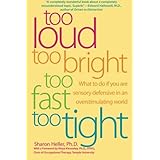
Too Loud, Too Bright, Too Fast, Too Tight: What to Do If You Are Sensory Defensive in an Overstimulating World… by Sharon Heller (Dec 2, 2003)
Thank you, Sharon Heller!
Dialing down the ticking clock
I did not know how to help Jackson with the super smell at the time.
I did know how to try to help with the super hearing.
Using concrete examples such as turning down the volume on a radio, we taught Jackson’s brain how to mentally dial down the volume of items that were distracting him in everyday life.
We had Jackson imagine a picture of radio volume dial out in front of him and and we had him reach out with his hand and turn the volume dial down.
This was not sufficient.
Finally the idea came of hooking up an imaginary small motor with a belt pulley attached to the volume control dial.
As the motor spins the volume dial down “endlessly,” the brain is able to dial down distracting sounds (such as a ticking clock, or tinnitus).
“Magic.” 😮
Doc Meek, South Jordan, Utah, USA, Sept 10, 2014
………………………………………………………………………………………………….
P.S. Highly Sensitive Granddaughter
Years later, the memory of Jackson came back to me when I was walking by a brick building with my granddaughter Katie (not her real name).
Suddenly (“for no reason”) she clapped her hands firmly over her ears.
“What’s happened?” I asked as we walked further away.
“Those pipes are so noisy,” she advised Grandpa, whose hearing is not perfect she knew.
Turns out that two “silent” exhaust pipes were softly “whooshing” air from an unheard fan highly distant from the pipe exit.
“Good luck, little girl,” I whispered inside my head. “I’m glad we know better now how to help you manage better.” ………………………………………………………………………………………………….
 Posted in learning, learning differences, Learning Difficulties, learning solutions, overcoming learning problems |
  Tags: Doc Meek, highly sensitive people, HSP, hypersensitive person, learning problems, sensitive hearing, sensitive smell, Sharon Heller, super sensitive hearing, super sensitive smell, too loud too bright too fast too tight |
  No Comments »
Lady Aquamarine Hides Secret Shame – Doc Meek


Image from: Photobucket.com
LADY AQUAMARINE HIDES SECRET SHAME
By Dr. J. Collins (“Doc”) Meek
Once upon a time an undersea lady of noble blood pined to become a mortal. Finally, miraculously, her wish was granted. She became mortal and soon joined a women’s precision swim team.
No longer burdened with royal demands and expectations, Lady Aquamarine (now simply known as Andrea) entered upon her human adventure with great gusto. Her undersea swimming talents made for high success on the women’s precision swim team.
Still, mortality was a real challenge in many ways. This created moments in her life that were difficult and joyful, both.
She and her team rose to the top of their rank and were known and lauded far and wide.
Painful Secret
But alas, the Aquamarine Lady had a painful secret. Very painful. Although she was lauded and loved by everyone, she covered her heart in shame within herself. She spoke to no one of her carefully guarded secret…
Life went on.

Image from: Photobucket.com
One day, she was talking with her mother (Lady Amelia of the North Sea) and told her that though she was highly successful as a precision swimmer (of course!), she was failing as a mortal because she could not read. Her mother reminded her that a return to her former undersea life was not possible.
“I Am So Ashamed”
“Why don’t you seek some way to learn to read?” her mother asked innocently. “Impossible!” exclaimed Andrea, thoroughly discouraged. “I’ve tried everything and nothing works. I’ll never be able to learn to read. I am so ashamed!”
“Better seek out the Old Man of the Sea,” her mother intoned and dove back into her accustomed watery domain.
The Old Man of the Sea was elusive.
Hope at Last
So Andrea asked her mortal friend Andilusia, “What can I possibly do?” Andilusia said, “I’ve heard there is a doctor who helps hopeless cases. The mothers love him because he gives them hope for their troubled children.
Andrea sought far and wide for this hopeful doctor. When she finally found him, she pleaded with him to help her learn to read. He asked her, “What is the one thing on earth you love most?”
Andrea immediately related her adventures as a precision team member. “I love the work and I love the team and I love the challenges.”
Then, for seemingly no reason, she blurted out, “But what I love the most is swimming in the aquamarine waters of the South Pacific islands!” She didn’t tell him this was in her former undersea life of course. She was afraid he would not believe her aquatic story.
The good doctor simply said. “Was it the warm waters that you loved?”
Aquamarine Hues Can Speak!
“Yes,” mused Andrea, “And mostly the incredible aquamarine hues!”
“You have no idea of the magnificence of the aquamarine hues,” she said, almost weeping.
“Well, it is obvious then,” said the good doctor, “we need to have those inspiring aquamarine hues teach you now to learn to read.”
“What!?” exclaimed Andrea, not willing to believe the good doctor knew that lovely-hued waters could talk with her as in her former undersea life.
Colored Overlays a Big Surprise
“Here,” said the good doctor, “Look at these gel colored overlays that are used to cover spotlights in the world of dramatic productions, presentations and plays.”
“Oh,” blurted Andrea, “Sometimes they put spotlights on us when our precision swim team is performing, especially in the evenings.”
Andrea immediately sought out one of the technicians who operated the spotlights for the team. He showed her an array of gel colored overlays, and she quickly picked several that were an exact match with the aquamarine waters of her South Seas experiences.
Andrea placed one of the aquamarine gels over the first page in a book she longed to read.
The “Small Black Marks” on the Printed Page Now Made Sense!
And she could not believe her eyes! The normal blur of quaint black marks on the page now shimmered gently in a quiet sea. She noticed that some of the quaint black marks (now softened by one of the aquamarine colored overlays) seemed to speak to her softly, seemed to make more sense to her now.
“My love of precision swimming now gives me a love of reading that I never ever thought I could achieve!” she rejoiced.
She wept for joy.
Defeats Dyslexia
With time, she learned individual words and phrases and loved to make sense of the whole sentence, then the whole paragraph and then the whole story.
And so, thanks to the colored overlays she was now using every day, she went merrily on her way! She got on with her life with great precision and great happiness.
Once thoroughly defeated, Lady Aquamarine now thoroughly defeats dyslexia.
……………………………
J Collins Meek, Ph.D., shows children and adults how to defeat dyslexia, ADHD, and many different kinds of learning problems. He is in private practice in Edmonton, Alberta, CANADA. He is an expert at creating innovative protocols to help children and adults triumph over learning difficulties.
Posted in learning, learning differences, Learning Difficulties, learning solutions, overcoming learning problems |
Tags: "hopeless", ADHD, aquamarine, aquamarine lady, colored overlays, defeat dyslexia, Doc Meek, Dyslexia, hope, hopeless cases, lady, Learning Difficulties, learning problems, mothers love him, precision, secret shame, South Seas, troubled children |
2 Comments »
Solve every ADHD challenge! FREE initial consult call (587) 400-4707 – Doc Meek
Today I am full of gratitude for adult clients who are overcoming learning problems and blooming like fresh flowers. 😮 – Doc Meek, Saturday, September 7, 2013, Edmonton, Alberta, CANADA
“Homework wars not worth it!” – Doc Meek
Thursday, January 24, 2013. Today I am grateful for those who challenge unproven conventional schooling practices. – Doc Meek

“What if you’re smarter than you think?” – Doc Meek
Thursday, May 10, 2012. Today, I am grateful for parents, teachers & students who endure. – Doc Meek
Do You or Your Student or Your Child Have Reading Difficulties or Learning Difficulties?
What if you are smarter than you think?
Einstein had overwhelming learning difficulties at school, and look at the creativity and accomplishment he brought to his life.

Click for image of Einstein: http://www.ideachampions.com/weblogs/archives/2011/09/the_timeless_wi.shtml
A series of articles to help mothers, teachers & students with reading problems is at: docmeek.com/mothers
Doc Meek, Thurs, May 10, 2012, Sherwood Park, Alberta, CANADA
“What if you are smarter than you think?”

THE LEARNING CLINIC WORLDWIDE, INC.
CANADA: Dr. Meek (587) 400-4707, Edmonton, AB
TONGA: Mele Taumoepeau, P.O. Box 81, Nuku’alofa
USA: Dr. Meek (801) 738-3763, South Jordan, Utah
For optimum brain health, ensure your heart health:
More on heart health: http://www.themeekteam.info
USA: Jeannette (801) 971-1812; South Jordan, Utah
CANADA: Jeannette (587) 333-6923, Calgary, Alberta
CANADA: P.O. Box 3105, Sherwood Park, AB T8H 2T1
=========================================
Posted in learning, learning differences, Learning Difficulties, learning solutions, overcoming learning problems |
Tags: Albert Einstein, Doc Meek, docmeek.com, grateful, Learning Difficulties, learning disabilities, learning problems, Moms, mothers, parents, reading difficulties, reading problems, Smarter than you think, students, teachers, Today I am grateful |
4 Comments »
November is Aviation Month! ~ Doc Meek (the “flying nut”)
Sunday, November 20, 2011. Today I am grateful to learn that November is National Aviation Month in the USA. Here I am, a “flying nut,” and I didn’t even remember that. My trusty colleagues at TeacherPlanet.com reminded me. ~ Doc Meek
| 1997 LEARJET 60 | 96 | US $2,995,000 | CA |
 |
For Sale – $2,995,000, N603SC; 5503 TT; New interior was completed in 2006, The entertainment system Airshow Genesys with DVD/CD with one flat screens, Operated part 135/91. | |
| SP Aviation Inc Phone: (510)812-9927 or (510)783-3584 Fax: (510)783-3587 |
Details & Photo(s) Send A Message Add To Aircraft Of Interest Share On   |
|
| Updated: 11/16/2011 12:40:00 AM | ||
Image from: http://www.controller.com/list/list.aspx?ETID=1&setype=1&Manu=LEARJET
Dear Santa,
I know it’s a little early to be writing to you.
However, I thought it might be worth alerting you ahead of time on one of my smaller wishes.
See, I’m a simple man with simple tastes. I don’t much care what kind of car I drive, and I do not have any overweening ambitions to be rich or anything like that.
All I want for Christmas is a simple little Lear Jet, OK?
Are you able to accommodate a humble wish like that?
Sincerely,
Doc Meek
P.S. Maybe you could lend me a million dollars as a down payment on a Lear Jet if you feel my wish competes with other people’s requests for flying machines (like sleighs–with or without reindeer)?
P.S.S. I help kids overcome learning difficulties of all kinds. Does that count in terms of you listing me as a good boy?
I had serious learning problems at first when I tried to learn to fly. Trying to drive the aircraft in 3-D space (maybe infinite-D space?) was not easy compared to driving a car in 2-D on the ground, eh? No fear. I got it in time. That’s what I tell the kids: “No matter what you are facing, you will get it in time. Look what Santa learned to do. What if you’re smarter than you think?”
Ho, Ho, Ho!
Doc Meek, Sun, Nov 20, 2011, Sherwood Park, Alberta, CANADA
Posted in learning, Learning Difficulties, learning solutions, overcoming learning problems |
Tags: aircraft for sale, controller.com, Doc Meek, flying, flying nut, Lear Jet, learning problems, National Aviation Month, National Aviation Month November, Santa, Santa Claus, What if you're smarter than you think? |
2 Comments »
“Music opens the channels of learning.” ~ Doc Meek



15 minutes Catching Up With Rex by CBS 88,713 views
Images from: http://www.youtube.com/watch?v=cCF1xSgyKXg&feature=relmfu
Friday, March 18, 2011. Today I am grateful to know that a child who was labeled severely autistic was found later to respond to music, even though he was super senstive to sounds and would hold his ears when exposed to singing.
Of course every autistic child does not grow up to be a musical genius. That is not the point of this article.
I use music in my private practice (Baroque music, about 60 beats per minute) to help open the channels of learning for children with a large array of learning problems.
Sometimes the music is simply background music in a classroom that helps almost every child in that classroom to learn more easily and achieve more.
Thanks to those who know, and who have taught us, that music opens the mind and soul!
Doc Meek, Fri, Mar 18, 2011, Sherwood Park, Alberta, CANADA
P.S. Here’s the book about Rex Lewis-Clack by his mother Cathleen Lewis:

Rex: A Mother, Her Autistic Child, and the Music that Transformed Their Lives – Hardcover (Oct. 28, 2008) byCathleen Lewis
P.S.S. Somebody told me that it is the “Ides of March” today. I know the reference is to Shakespeare and I do not know the full import of the phrase.
Can anybody “out there” give us some more information on the “Ides of March?”
Posted in learning, learning differences, Learning Difficulties, learning solutions, overcoming learning problems |
Tags: active learning, brain rules, Cathleen Lewis, changing your behavior, changing your mind, Doc Meek, docmeek, Dr J Collins Meek, Dr Meek, Dr. J. Collins Meek III, grateful, gratitude, happiness, head heart hands hope, J Collins Meek PhD, learning problems, Lewis, music, music helps learning, Rex, Rex Lewis, Rex Lewis-Clack, self-involvement in learning, success, teacher training |
2 Comments »
“Technological marvels can be hazardous to human health.” ~ Doc Meek
Wednesday, January 26, 2011. I am grateful that someone made me aware, at the last minute, that the Edmonton Public School Board was addressing a “WiFi Motion” at their meeting last evening, January 25, 2011. Thanks to the Board Secretary, I was able to forward to the Trustees a quickly-drafted “one-pager” brief on the subject of reliance on Health Canada and the World Health Organization for safety standards relative to WiFi (WiFi is a trademark of the WiFi Alliance).
The WiFi Alliance Sponsor Companies
For a complete and lengthy list of member companies of the WiFi Alliance, see: http://www.wi-fi.org/our_members.php#sponsor
 |
 |
 |
 |
 |
 |
 |
 |
 |
 |
 |

All company images above from: http://www.wi-fi.org/our_members.php#sponsor |
WiFi Motion at Edmonton Public School Board Meeting, Jan 25, 2011
(A “one-pager” brief similar to the following was emailed to the Trustees the day before their Jan 25th meeting)
“A brief introduction: I am a learning specialist, not a medical specialist. I have been in private practice for many years, encouraging students, parents, teachers and educational administrators to utilize strategies that help to overcome learning difficulties.
“The Board’s WiFi motion (WiFi is a trademark of the WiFi Alliance) proposes to rely upon Health Canada and the World Health Organization for safety standards relative to the installation of wireless devices in schools. Trustees should consider broadening this WiFi motion, slightly and vitally. It would be prudent, I think, to include in the motion reference to other solid research data, in addition to that adduced by Health Canada and the World Health Organization (WHO). Published standards by such large organizations have a tendency to lag behind solid research.
“Further, much of the well-publicized research upon which Health Canada and WHO rely is industry-funded research, and there is a tendency for such studies to find no harm in the devices which industry produces. This is a natural sequence of events. No organization wants to undermine its own means of existence and we can’t fault them on that.
“What we can do is protect the health of students by the inclusion in the WiFi motion of reference to additional independent solid and reliable research.
“Many of you may recall that decades ago a very convenient and useful technology was introduced into shoe stores. People could place their feet in a slot at the bottom of the machine and see their toes wriggling in a pair of new shoes, to see for certain if the fit of the shoe was good. This seemed to be a great and convenient technological aid, at the time.
“Experts assured us that these fluoroscopy machines were perfectly safe. The subsequent rise in cancer rates came as an unpleasant surprise, because it was not generally perceived, at that time, that such ionizing radiation presented a serious health hazard.
“Independent and reliable research is now cautioning us that even non-ionizing electromagnetic radiation (EMR), such as that emitted by numerous wireless devices now in common use in homes, schools and workplaces, presents serious health hazards.
“One man wryly noted that they don’t call WiFi “hot spots” for nothing.
“We need to pay attention to this vital knowledge, ahead of time, not after the fact.
“Central nervous system disturbances caused by non-ionizing EMR (electromagnetic radiation) have been documented, in addition to other kinds of human cellular damage.
“In other words, EMR (electromagnetic radiation) impacts the child’s brain cells negatively.
“In my many years of working as a learning specialist with children with learning difficulties, I have learned that non-ionizing EMR (electromagnetic radiation) damages the brain’s capacity for learning.
“Would it not be the height of irony for schools to install great and convenient technological learning aids that damage the child’s capacity to learn?”
– J. Collins Meek, Ph.D.
Email: docmeek@gmail.com; Website: https://docmeek.com
The Trustees voted 6 to 3 to continue to rely on Health Canada and WHO for safety standards for students, thus guaranteeing that students in schools where WiFi is installed will be bathed all day in health-hazardous non-ionizing EMR (electromagnetic radiation).
Not prudent, in my view.
Doc Meek, Wednesday, January 26, 2011, Sherwood Park, Alberta, CANADA
Posted in learning, learning differences, Learning Difficulties, learning solutions, overcoming learning problems |
Tags: active learning, brain rules, changing your behavior, changing your mind, Doc Meek, docmeek, electromagnetic radiation, EMR, grateful, gratitude, head heart hands hope, learning problems, learning tools, self-involvement in learning, students bathing daily in non-ionizing radiation, success |
2 Comments »
“Innovative Perlmutter Health Center.” – Doc Meek
Wednesday, November 24, 2010. Today I am grateful for David Perlmutter, M.D., a Board-Certified Neurologist with a worldwide practice centered in Naples, on the west coast of Florida.
Images and text below from Dr. Perlmutter’s website: http://www.perlhealth.com
“Raise a Smarter Child by Kindergarten”

by David Perlmutter, MD, FACN, ABIHM Learn More »

Dr. Perlmutter works innovatively with a wide variety of neurological and nutritional issues and preventive medicine, including helping adults and children overcome learning problems.
This makes him a hero in my eyes, as I have been helping adults and children triumph over learning difficulties for more than 30 years now.
Thank you, Dr. Perlmutter, for inspiring hope for children and parents and others!
Doc Meek, Wednesday, November 24, 2010, at the Super 8 Motel in Dania Beach, Florida (on the east coast of Florida, opposite Dr. Perlmutter’s office on the west coast at Naples).
J. Collins Meek, Ph.D. (Doc Meek)
“What if you are smarter than you think?”
Learning Specialist https://docmeek.com
For brain health, ensure heart health (short video):
http://www.amiraclemolecule.com/themeekteam
More on heart health http://www.themeekteam.info
Ph (801) 971-1812 (Jeannette); Fax [801] 282-6026
THE LEARNING CLINIC WORLDWIDE, INC.
CANADA: P.O. Box 3105, Sherwood Park, AB T8H 2T1
TONGA: Mele Taumoepeau, P.O. Box 60, Nuku’alofa
USA: 3688 W 9800 S, #138, South Jordan, UT 84095
=======================================
Posted in learning, learning differences, Learning Difficulties, learning solutions, overcoming learning problems |
Tags: active learning, ADD, ADHD, anger management, brain rules, changing your behavior, changing your mind, Doc Meek, docmeek, grateful, gratitude, happiness, head heart hands hope, hope, humility, Learning Difficulties, learning disabilities, learning problems, memory, memory problems, self-involvement in learning, success, teacher training |
3 Comments »